About John Agnew & The Wealth Collective
I started my career at Merrill Lynch. Then went to Morgan Stanley. Then I left. Not because I failed. Because I succeeded — and didn't particularly like what I saw.
At the large wirehouse firms, the advice business works a certain way. Products get sold. Recommendations get shaped. I knew early on that I couldn't build the kind of practice I wanted to build inside that system. So in 2020, I started The Wealth Collective — a fee-only, independent Registered Investment Advisory firm — to do things differently. No products to push. No quotas to fill. Just straightforward, fiduciary advice.
That decision cost me the comfort of a well-known brand name. What it gave me was the ability to look every client in the eye and tell them honestly: every recommendation I make is because I believe it's right for you.
On credentials — and why they matter to me
Most financial advisors hold one or two professional designations. I've pursued significantly more than that — and let a few others lapse when I concluded they weren't adding enough depth to be worth maintaining.
It's a reflection of something I feel genuinely strongly about: the people who trust me with their finances have worked hard for their money. The decisions I help them make can have a profoundly positive effect on their lives over time. That's a serious responsibility, and I think it demands a serious commitment to knowing as much as possible, and working hard to keep up-to-date.
What these credentials mean in plain English:
CFA — Chartered Financial Analyst. The most rigorous investment credential in the industry. It covers areas like portfolio management, financial analysis, economics, and ethics across three levels of examination. Fewer than one in five candidates who start the program complete it, and only a very small percentage pass each level on their first attempt. It’s a grueling course of study that requires a huge amount of dedication, and many hundreds of hours per level studying alone in a room while family and friends wait patiently.
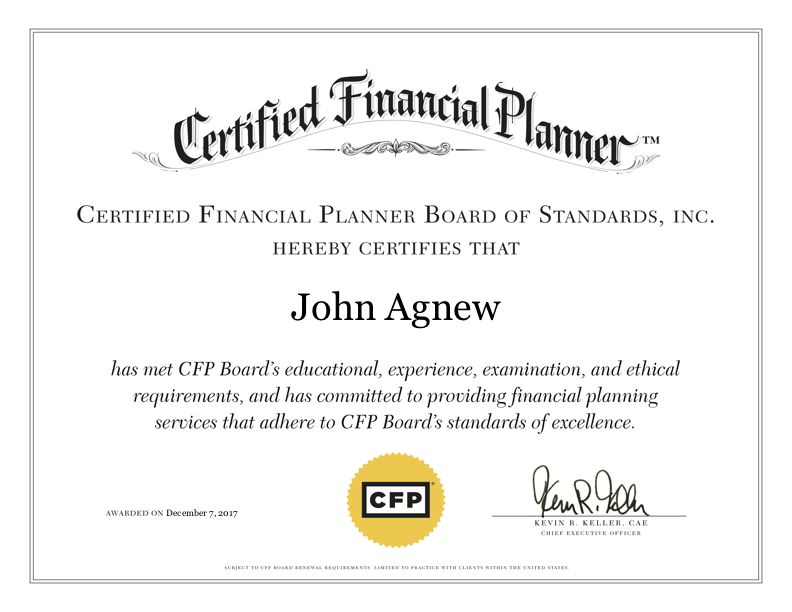
CFP® — Certified Financial Planner™. The standard-setting credential for comprehensive financial planning — retirement, tax, estate, insurance, and investment planning in an integrated framework.
RICP® — Retirement Income Certified Professional™. Specialist training in retirement income planning — Social Security optimisation, Medicare, sustainable withdrawal strategies, longevity risk, and long-term care. Most advisors don't hold this one.
CLU® — Chartered Life Underwriter®. Deep training in life insurance, risk management, and estate planning for business owners and professionals. Particularly relevant for clients with complex insurance needs.
What this practice looks like
The Wealth Collective is my firm. I am the advisor. When you become a client, you work with me — not a junior associate, not a rotating team, not an algorithm. Me.
That's a deliberate choice. The kind of planning I do — integrated, tax-aware, genuinely personalised — requires a deep understanding of each client's complete picture. That understanding takes time to build, and it doesn't transfer well. I'd rather serve fewer clients very well than hundreds of clients sort-of.
I also have a written succession plan in place. Should anything ever happen to me, there is a clear, documented process to ensure clients are taken care of and their financial lives are not left in disarray. I mention this not to be morbid, but because a solo practice without a succession plan is an unacceptable risk to impose on the people who trust you.
What I actually do in practice
Most of financial planning isn't black and white. There's rarely one objectively correct answer — there are trade-offs, priorities, probabilities and potential scenarios to consider, and values that differ from one person to the next. My job isn't to tell clients what to do. It's to make sure they understand their choices clearly, to help them think through the implications honestly, and arrive at decisions that feel right to them — decisions that I can also stand behind professionally and feel good about.
Sometimes that means delivering uncomfortable news. I've sat with clients and shown them that their spending patterns, left unchanged, would significantly compromise their retirement. I've found errors on tax returns — deductions incorrectly claimed, contributions misclassified — that needed to be addressed before they became bigger problems. I've reviewed accounts with no beneficiary listed at all, and accounts still naming ex-spouses from marriages that ended years ago.
The clients I work best with are curious and engaged. They ask good questions. They share information openly. And then they let me do my job. That combination — an informed, participating client and an advisor who takes the responsibility seriously — is where the best outcomes come from.
Why every client here came through a referral
The Wealth Collective has never run an advertisement. I have never purchased a lead or paid for a referral, and I never receive compensation for sending a client to another professional.
Every client relationship here began because someone — an existing client, a CPA, a tax attorney — thought enough of their own experience to mention my name to someone they care about. That means a great deal to me. It's also, I think, the only honest measure of whether an advisory practice is actually doing its job.
If you're reading this because someone pointed you here, I don't take that lightly.

John Agnew, CFA, CFP®, RICP®, CLU®